PRESENTING SUPERB RESEARCH THAT ADVANCES THE FIELD OF EDUCATION
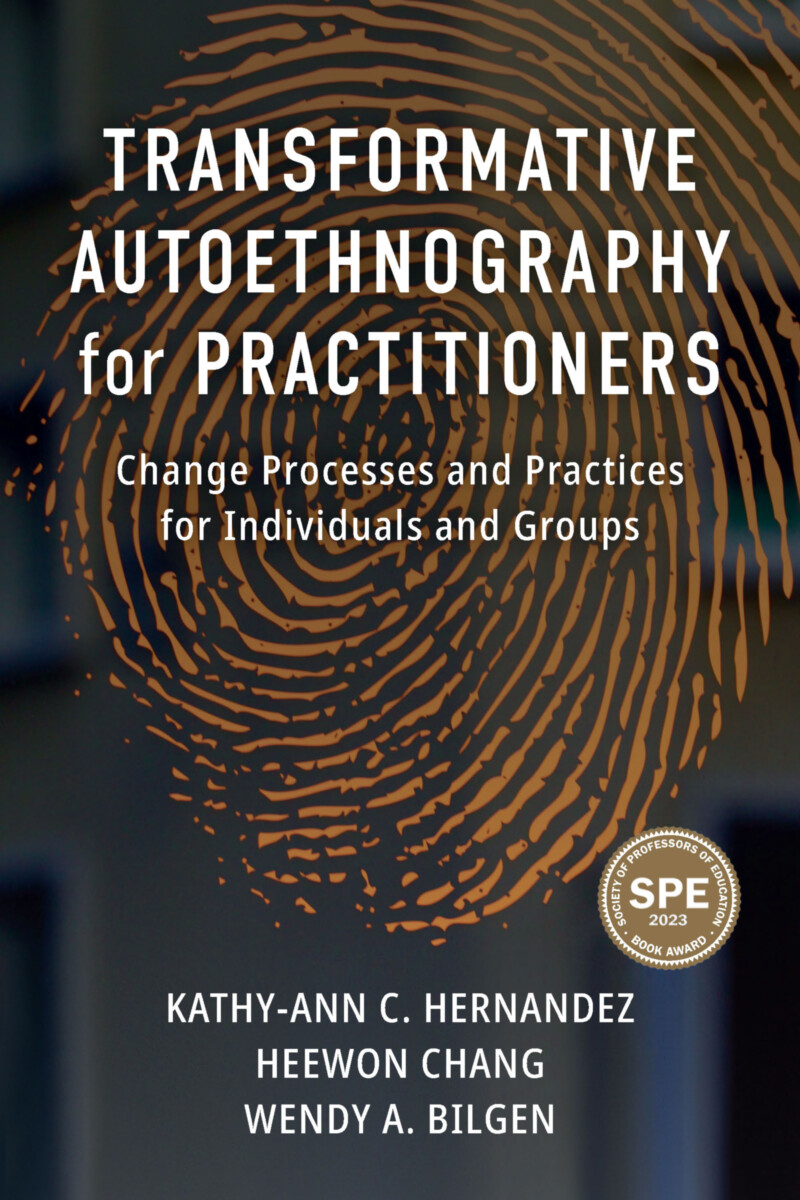
Transformative Autoethnography for Practitioners
Change Processes and Practices for Individuals and Groups
- Publisher
Myers Education Press - Published
14th March 2022 - ISBN 9781975504878
- Language English
- Pages 160 pp.
- Size 6" x 9"
- Request Exam Copy
E-books are now distributed via VitalSource
VitalSource offer a more seamless way to access the ebook, and add some great new features including text-to-voice. You own your ebook for life, it is simply hosted on the vendor website, working much like Kindle and Nook. Click here to see more detailed information on this process.
- Publisher
Myers Education Press - Published
30th March 2022 - ISBN 9781975504892
- Language English
- Pages 160 pp.
- Size 6" x 9"
- Request E-Exam Copy
Library E-Books
We are signed up with aggregators who resell networkable e-book editions of our titles to academic libraries. These editions, priced at par with simultaneous hardcover editions of our titles, are not available direct from Stylus.
These aggregators offer a variety of plans to libraries, such as simultaneous access by multiple library patrons, and access to portions of titles at a fraction of list price under what is commonly referred to as a "patron-driven demand" model.
- Publisher
Myers Education Press - Published
30th March 2022 - ISBN 9781975504885
- Language English
- Pages 160 pp.
- Size 6" x 9"
Can transformation be the primary goal of autoethnographic research? In this book, the authors present a compelling case that this is indeed possible. Since autoethnography first appeared as a nascent approach to social inquiry, much has been written about it as a useful addition to the field of qualitative research methods. Over the years, its usage has been extended across various disciplines including the humanities, human services, social sciences, leadership studies, engineering, education, counseling, and even medical education. Notably, the primary function of autoethnography to advance our understanding around sociocultural phenomena has been increasingly paired with a parallel function of the many ways in which this research method can also contribute to practice. However, though its contribution to scholarship is well documented, less has been written about its practical usage as the focal point of inquiry. Yet there is growing evidence that one of the emerging strengths of autoethnography is its transformative capabilities. In Transformative Autoethnography for Practitioners, Hernandez, Chang and Bilgen turn the spotlight on autoethnography as a tool for practitioners where the primary goal is to solve real world problems by facilitating transformational change at the individual, group and/or organizational levels. They draw on existing scholarship as well as their collective work and expertise to provide a Transformative Autoethnographic Model (TAM) for use by practitioners who are intent on effecting such changes in their respective contexts.
The book contains seven chapters. Chapters One through Three provide the theoretical grounding for a transformative autoethnography model. Chapter One begins with a broad overview of autoethnographic research and the unique characteristics of this method that makes it especially suited for effecting transformational learning. In chapters Two and Three, the authors provide a quick review of the literature relevant to individual autoethnography and collaborative autoethnography respectively. Each chapter discussion is centered around explicating the transformative elements of the method as well as how it is able to effect change at the individual, group, and organizational level. Chapters Four through Six focus on the praxis of transformative autoethnography. In Chapter Four, the transformative autoethnography model (TAM) is presented in detail and templates are provided for its application. Chapters Five and Six show the application of the TAM in a variety of settings. The book ends with a final chapter discussion on the continuing evolution of autoethnographic explorations, as well as future applications for the TAM model in a fast changing digital landscape.
Perfect for courses such as: Research Methods in the Social Sciences | Qualitative Research Methods | Narrative Research | Advanced Qualitative Research Methods | Coaching and Consulting | Leading Change
“There is no other guide to transformative autoethnography research that a) focuses on transformation as the intended goal of the research, b) has an explicit aim to create change in practice, and c) provides a useful model to follow. . . . As someone new to the method of autoethnography, the authors have convinced me of the power of transformative autoethnography to create change.”
--Review excerpt from Vanessa Stafford, Director of Academic Learning, Kaplan Business School in Journal of Applied Learning & Teaching, Vol. 5 No. 2 (2022)
“What a remarkable and timely contribution to autoethnographic research! In this thoroughly researched book, the authors clear the path both theoretically and methodologically for their model of transformation as a meaningful and worthy goal of autoethnography for scholars and practitioners alike. They not only talk the talk; they walk the walk in explaining and demonstrating how transformation can be a vital part of the entire research process. This book itself is transformative in the way it lays out possibilities and processes for doing autoethnography as a change agent for ourselves as researchers, for engaging and improving the life of readers and participants in our studies, and for assisting organizations and communities to solve real-life problems. What a gift! Especially to practitioners, but also to all of us who value autoethnography for the good it can add to our world.”
Carolyn S. Ellis, PhD, Distinguished Professor Emerita of Communication and Sociology, University of South Florida, USA Recipient of Numerous Publication and Teaching Awards on Autoethnography
“Hernandez, Chang, and Bilgen—experts and leaders in collaborative autoethnography—offer a thoughtful, thorough, and easy-to-follow text that foregrounds the practical, interdisciplinary, and transformative potentials of/for doing autoethnography. Throughout, they provide astute descriptions of the autoethnographic research and writing processes, present fresh insights about working with self and others, and show how and why autoethnography is indeed “life-changing work” (p. xvii). A conversational and comprehensive book that will be of great interest to new and established autoethnographers alike.”
Tony E. Adams, PhD, Caterpillar Professor and Chair of the Department of Communication, Bradley University, USA Founding Co-editor of The Journal of Autoethnography
“In this engaging volume, Kathy-Ann Hernandez, Heewon Chang, and Wendy Bilgen share the transformational potential of autoethnography. This is an excellent resource for practitioners seeking to learn more about autoethnography and how to implement it to improve understanding of self, others, and society. The thoughtful process of study and change encouraged by the authors can be greatly life-enhancing. The personal stories and the models shared make the material highly accessible, an important dimension of the transformative power of the book.”
Sherry Marx, PhD, Professor, School of Teacher Education and Leadership, Utah State University, USA Editor in Chief of the International Journal of Multicultural Education, Co-Author of Our International Education: Living, Teaching, and Parenting Abroad
“Engaging in autoethnography as writer, collaborator, and reader constitutes a transformative act of love, when love is understood – notably after bell hooks – as the willing act of nurturing compassionate, holistic, liberating and mutually respectful growth in self and others. Written by three well-respected, trailblazing experts of autoethnography, this important book is a gift to those willing to immerse themselves in the practical and life-changing power of the approach. At individual, group, organizational, institutional, and cultural levels, this has never been more necessary!”
Alec Grant, PhD, Unaffiliated Independent Scholar, UK, Recipient of the 2020 International Conference of Autoethnography Lifetime Contribution Award
“Transformative Autoethnography for Practitioners: Change Processes and Practices for Individuals and Groups is a must-read for autoethnographic researchers. The captivating combination of a wealth of diverse insider experiences, passion and deep grasp of the challenges, opportunities and the subject literature ensures a perfect fit for the audience. The clear, inviting and confident writing style will inspire practitioners and novice researchers to work through the examples and templates as individuals or in collaboration with others. To embrace the enriching experience of transformative autoethnography (consequential or purposefully pursued) fully informed of the need to always strive for scientific rigor. I am looking forward to a new generation of transformative autoethnographic researchers and practitioners.”
Ina Fourie, DLitt et Phil, Full professor, Head: Department of Information Science and Chair: School of Information Technology University of Pretoria, South Africa
List of Figures and Tables
Acknowledgments
1. Transformative Autoethnography
2. Individual Autoethnography (IAE ) for Transformation
3. Collaborative Autoethnography (CAE) for Transformation
4. Transformative Autoethnography Model
5. TAM Applications for Individual Autoethnography
6. TAM Applications for Collaborative Autoethnography
7. TAM and Future Directions
About the Authors
Index
Kathy-Ann C. Hernandez
Kathy-Ann C. Hernandez, Ph.D. is a Professor of Leadership in the College of Business and Leadership and co-chair of the Ph.D. Program in Organizational Leadership at Eastern University in Pennsylvania. Dr. Hernandez is also CEO of Nexe Consulting and regularly consults with school districts, churches, schools, government offices, and colleges and universities nationally and internationally. She is a scholar/activist who has collaborated to conceptualize, secure funding, implement, manage and evaluate several university-community partnership programs. In recognition of her work, she was awarded the Marlene Smigel Korn Humanitarian Award for excellent contribution in teaching, scholarship and/or service from the College of Education at Temple University. Dr. Hernandez is a trained research methodologist who is actively involved in conducting research, facilitating research workshops, and teaching and advising on social science research methods and program evaluation. She has authored several book chapters and articles and serves as a co-editor for the International Journal of Multicultural Education. She is the co-author of Collaborative Autoethnography (2013) with Heewon Chang and Faith Wambura Ngunjiri, as well as the author/presenter on several other autoethnographic-related scholarship projects. Her work has appeared in the Handbook of Autoethnography, The International Journal of Qualitative Studies in Education, and The Journal of Research Practice. Her career mission is to bridge the gap between scholarship and practice through the sound application of research findings to solving real world problem. To this end, her research is focused on the salience of race/ethnicity, gender, spirituality, and social context in identity formation, leadership development, and social and academic outcomes for marginalized populations. She is also committed to interrogating and fostering the leadership development experiences of women and minorities in academic and public settings.
Heewon Chang
Heewon Chang, PhD., serves as Professor and Chair of the PhD in Organizational Program at Eastern University in the USA. When she began her academic career as an assistant professor of education, her teaching focused on undergraduate and Master’s students. For the last 20 years, her teaching focus has shifted to PhD students. She has taught courses in qualitative research methods, program evaluation, educational leadership, systems thinking, and organizational and systematic justice and equity. She has also supervised over 30 doctoral dissertations to completion. In addition to teaching and dissertation supervision, she founded and had served on two academic journals as their founding Editor-in-Chief for over 20 years. One of them, International Journal of Multicultural Education, has been continuously publishing since 2007. As an author, she has published six books. Her dissertation research became her first book, Adolescent Life and Ethos: An Ethnography of a US High School (1992). Over the last two decades, she has dedicated her time to advancing autoethnography as a social science qualitative research method. Her solo and collaborative efforts have resulted in several articles, book chapters, and books such as Autoethnography as Method (2008); Spirituality in Higher Education: Autoethnographies (2011); Collaborative Autoethnography (2013); and Transformative Autoethnography for Practitioners (2020). Her teaching and publishing efforts reflect the pedagogical approach of collaboration and mentoring. Through her collaborative work, she models how to listen attentively, learn with humility, and support others’ success genuinely. Her recent accomplishment includes bringing over 40 students, alumni, and faculty from her PhD in Organizational Leadership program to create a collection of essays on leadership and followership. The book, Leadership and Followership for 100 Years: Lessons from Practice, Research, & Reflection (2025), resulted from this community effort.
Wendy A. Bilgen
Wendy A. Bilgen is an online adjunct instructor for Cornerstone University, Professional and Graduate Studies (PGS). She also maintains a private counseling and consulting practice in Turkey where she has lived for the past two decades. Her Ph.D. in Organizational Leadership is from Eastern University and her dissertation was an autoethnographic study joining dialogical self theory and intersectionality with social justice leadership identity theories to explore how diverse, multifaceted personal identities interact within challenging power-filled contexts. Her professional and research interests have aligned with her life purpose exploring and developing narrative practices through diverse forms of inquiry. Interacting with the stories and experiences of self and others at the intersection of identity, culture, and spirituality have focused her activities as an edge-walking practitioner, dividing time between teaching, counseling, speaking, research, and writing in the U.S. and Turkey. Through her work she hopes that voices normally held at the margins of society would be stimulated to speak new wisdom and knowledge into all levels of society in order to stimulate social innovation and healing in individuals, organizations, communities, and societies around the globe.